"*" indicates required fields

Polypropylene Pall Rings are lightweight random packings used in packed columns for gas–liquid contact. Their open structure can support effective contact while limiting resistance to gas flow, but performance depends on the column and operating conditions. Material compatibility matters. Polypropylene’s temperature and chemical limits must be checked against the actual process, not inferred from a product photograph.
This guide compares ten worldwide suppliers through practical purchasing criteria: available ring sizes, stated surface area and void fraction, dimensional consistency, technical documentation, sample access, lead times, and export support. Ask for drawings and test data. Check whether quoted figures apply to the exact size and grade being offered. A pallet of rings may look uniform from above, yet inconsistent dimensions can affect how packing distributes through a column. Small details count.
Chemical-engineering author Richard K. Sinnott is a relevant reference for packed-column design, but a verifiable direct quotation from him about Polypropylene Pall Rings is not available here. I will not invent one. That restraint matters. Supplier rankings should also be treated as a starting point, not a substitute for process-specific engineering review. Compare evidence, confirm material suitability, and ask clear questions before selecting a vendor. A confident claim is not test data.
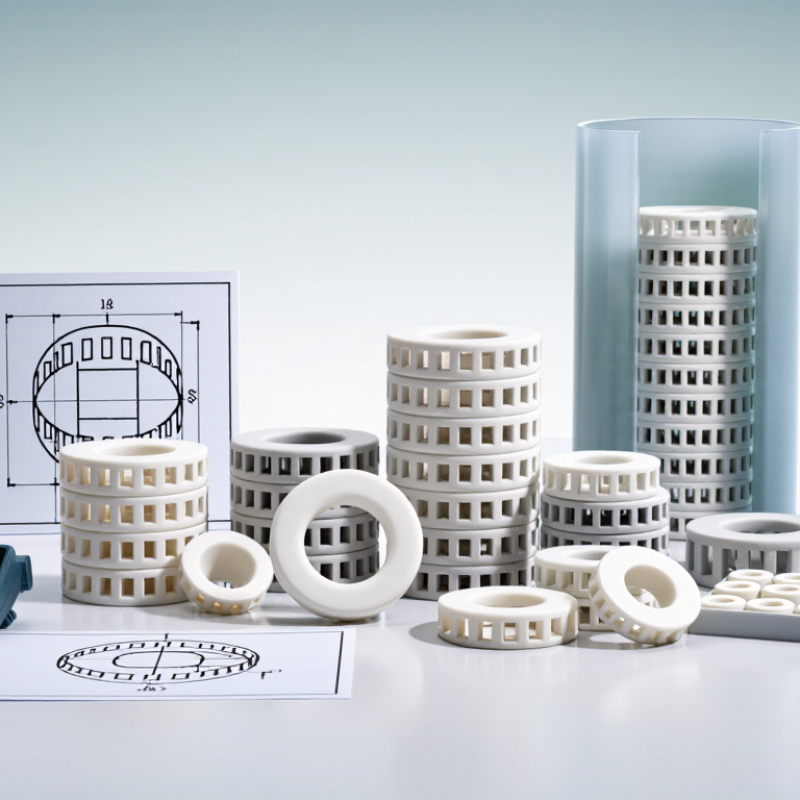
Top 10 Polypropylene Pall Rings Suppliers Worldwide
Polypropylene Pall Rings: Structure, Materials, and 90–95% Typical Void Fraction
Polypropylene Pall Rings are random tower packings designed to improve gas-liquid contact. Their open windows, internal ribs, and curved surfaces create many flow paths. Compared with older ring shapes, they usually reduce wall contact and support better liquid distribution.
Polypropylene is lightweight, corrosion resistant, and practical for many absorption and stripping services. It can handle numerous aqueous chemicals, but temperature limits require careful review. Actual performance depends on fluid composition, pressure, operating temperature, and mechanical loading. A supplier should provide material data, dimensional tolerances, and service recommendations.
The typical void fraction is about 90–95% by volume. This open space lowers pressure drop and leaves room for vapor movement. However, the quoted value is not universal. Ring size, manufacturing design, bulk density, and installation method can change the result. A loose, uneven bed may perform poorly despite attractive specifications.
Experience with packed towers shows that distribution matters as much as packing geometry. Inspect sample pieces for flash, deformation, and blocked openings. Ask for test methods rather than accepting a percentage alone. Supplier comparisons should include consistency between batches, packaging quality, technical support, and documented quality control. Some specifications look precise. They still need questioning.
Anonymous global supplier profiles based on commonly available polypropylene Pall ring specifications. The profiles are provided for technical comparison and are not a verified commercial ranking.
| Profile | Typical Manufacturing Region | Primary Material | Common Nominal Sizes | Typical Void Fraction | Typical Operating Temperature | Structural Characteristics | Common Applications | Key Specification Checks |
|---|---|---|---|---|---|---|---|---|
| Supplier Profile 01 | East Asia | Virgin polypropylene; injection-molded grade | 25, 38, 50, 76 mm | 90–95% | Approximately 80–100°C, depending on chemical service | Open cylindrical geometry with internal windows and outward-curved ribs | Gas scrubbing, absorption, stripping, and air pollution control | Material purity, dimensional consistency, pressure drop, and packing density |
| Supplier Profile 02 | South Asia | Polypropylene with UV-stabilized options | 16, 25, 38, 50 mm | 90–94% | Generally selected for low-to-moderate temperature systems | High open area designed to improve liquid redistribution and vapor contact | Water treatment, chemical absorption, and corrosive-gas service | UV stabilization, chemical compatibility, wall thickness, and ring deformation |
| Supplier Profile 03 | Western Europe | Virgin PP or electrically dissipative PP grades | 25, 38, 50, 76 mm | 91–95% | Application-specific; temperature must be checked against the chemical medium | Large open passages reduce liquid holdup and help limit flooding tendency | Industrial gas treatment, solvent recovery, and process absorbers | Flammability requirements, antistatic performance, bulk weight, and QA documentation |
| Supplier Profile 04 | North America | Industrial-grade polypropylene | 38, 50, 76 mm | 90–95% | Typically used where PP chemical resistance is more important than high heat resistance | Flexible ribs and windows provide a high surface-area-to-volume ratio | Scrubber towers, packed columns, and wastewater odor control | Specific surface area, compressive strength, pressure-drop curves, and lot traceability |
| Supplier Profile 05 | Southeast Asia | Virgin PP with color-coded size options | 25, 38, 50 mm | 90–94% | Usually specified for ambient and moderately warm chemical processes | Lightweight ring body with multiple openings for improved phase contact | Acid-gas removal, ventilation scrubbers, and water-treatment columns | Color consistency, dimensional tolerance, fines content, and resistance to brittle fracture |
| Supplier Profile 06 | Middle East | UV-resistant polypropylene for outdoor installations | 38, 50, 76 mm | 91–95% | Thermal and UV exposure should be evaluated for outdoor service | Open ribbed construction supports high gas capacity and relatively low pressure loss | Desalination pretreatment, refinery scrubbing, and industrial exhaust treatment | UV package, outdoor aging, temperature cycling, and chemical resistance |
| Supplier Profile 07 | Eastern Europe | Virgin or certified recycled-content PP, subject to process requirements | 25, 38, 50, 76 mm | 90–95% | Selected according to process temperature, chemical exposure, and mechanical load | Low-density packing with curved ribs that help reduce nesting between elements | Biogas cleaning, chemical processing, and wastewater deodorization | Recycled-content declaration, melt-flow index, odor, contamination, and impact strength |
| Supplier Profile 08 | Latin America | Chemical-resistant polypropylene | 16, 25, 38, 50 mm | 90–94% | Commonly used in ambient-temperature packed-bed equipment | Smaller sizes provide more geometric surface area but may increase pressure drop | Small and medium scrubbers, laboratory systems, and water-treatment units | Size selection, liquid distribution quality, pressure drop, and packing uniformity |
| Supplier Profile 09 | Oceania | UV-stabilized virgin polypropylene | 38, 50, 76 mm | 91–95% | Suitable for many ambient outdoor systems when UV protection is specified | Large void volume promotes high throughput and reduces risk of liquid holdup | Marine infrastructure, wastewater treatment, and coastal air scrubbing | Salt exposure, UV resistance, buoyancy, bulk density, and installation handling |
| Supplier Profile 10 | Africa | Industrial polypropylene with application-specific additives | 25, 38, 50, 76 mm | 90–95% | Final rating depends on the process fluid, concentration, and operating temperature | Random packing geometry increases turbulence and provides repeated gas–liquid contact | Mining ventilation, mineral processing, acid mist control, and industrial scrubbers | Acid compatibility, abrasion resistance, supply continuity, inspection reports, and spare availability |
"*" indicates required fields