"*" indicates required fields
China has become a major manufacturing base for automated welding equipment, supported by strong machinery production, skilled engineering teams, and extensive metalworking supply chains. This article examines China Top Auto Pipe Welding Machine Manufacturers through practical performance, technical capability, and quality-control evidence. An Auto Pipe Welding Machine is not merely a rotating fixture with a welding torch. It must coordinate alignment, travel speed, shielding gas, heat input, and repeatable pipe positioning.
Industry data shows why this equipment matters. The International Federation of Robotics reported 541,302 industrial robots were installed worldwide in 2023, confirming the continuing shift toward automated production. Welding remains one of the most practical automation applications because consistent torch movement can reduce variation between operators. Grand View Research also identifies automation and digital control as important trends in the global welding equipment market. However, market growth alone does not prove manufacturer quality.
Reliable suppliers should demonstrate compliance with recognized welding and quality practices, including ISO 9001 and relevant ISO 3834 requirements. ISO 14732 is also useful when evaluating personnel responsible for mechanized and automatic welding operations. Buyers should inspect real details: stainless-steel pipe samples, root penetration, orbital alignment, carriage stability, and post-weld inspection records. Ask for traceable test results.
Some claims still need questioning. “Fully automatic” can mean different things. A machine may automate rotation but require manual torch adjustment. Therefore, this guide compares manufacturers by engineering experience, customization ability, service response, documentation, and measurable weld consistency. Factory visits, sample testing, and independent verification remain essential before purchase. Reliable decisions take evidence, not impressive brochures.
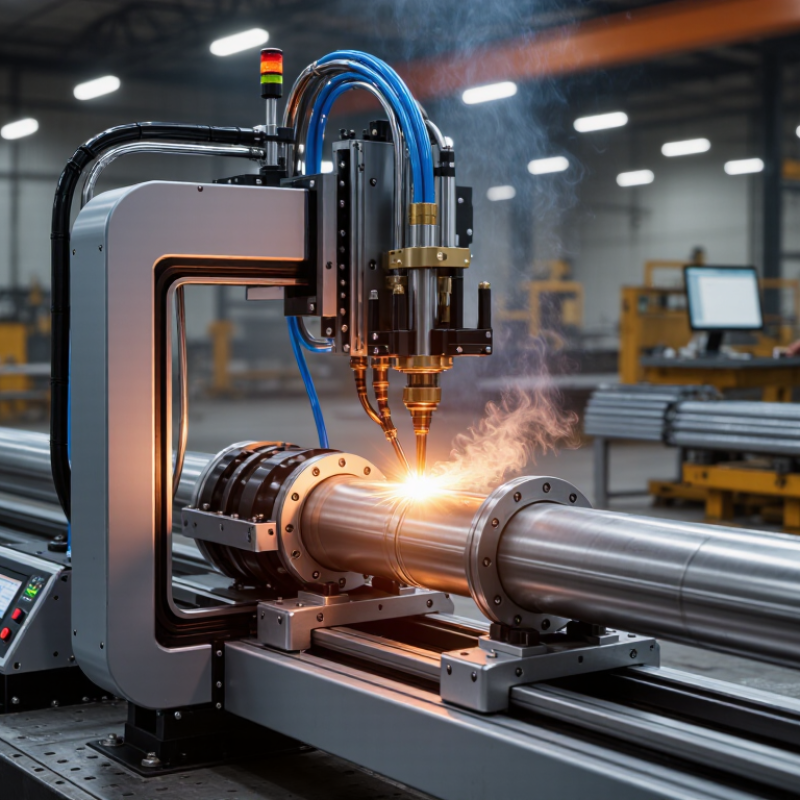
Automatic pipe welding machines for 10–100 mm tubes must handle changing diameters without losing arc stability. Wall thicknesses from 0.5–3 mm demand careful heat control. Orbital TIG systems suit thin stainless steel and aluminum tubes, especially where clean internal welds matter. MIG or MAG systems offer higher deposition rates for thicker sections and longer production runs. Laser welding can reduce distortion, but it needs precise joint preparation and stable fixturing.
The 2024 International Federation of Robotics report recorded 541,302 industrial robots installed worldwide in 2023. This growth reflects stronger demand for repeatable welding cells. For small tubes, servo-driven rotation, automatic wire feeding, and closed-loop current control are practical features. A 10 mm tube may require a compact torch and narrow clamping jaws. A 100 mm tube needs stronger support, better alignment, and more powerful rotation control. Purging also matters when oxidation could damage the inner surface.
Shop trials often reveal an uncomfortable detail: a machine that performs well on 2 mm walls may struggle at 0.5 mm. Speed, pulse frequency, shielding gas flow, and torch distance need separate recipes. ISO 3834 emphasizes controlled welding quality systems, but paperwork cannot correct poor fit-up. One assumption remains risky. Buyers should test actual tube material, diameter, and wall combinations before selecting equipment.
Comparing China’s top auto pipe welding machine manufacturers requires more than checking output speed or quoted price. ISO 9001 indicates a controlled quality management system, including purchasing, inspection, corrective actions, and customer support. It does not prove that every machine performs equally well. Review the certificate scope, issuing body, validity date, and covered production site.
ISO 3834 is more specific to welding quality. A capable manufacturer should provide welding procedure specifications, qualified operator records, material traceability, and inspection reports. Ask to see calibration records for current, voltage, and alignment tools. During a factory visit, inspect weld samples, fixture rigidity, cable routing, and the cleanliness of the welding area. Small details matter. A neat demonstration weld may hide weak process control.
CE compliance should be verified through a declaration of conformity, technical documentation, risk assessment, and relevant test records. CE marking alone is not an independent quality award. Confirm that the declared machine model matches the delivered equipment and its electrical configuration. Experienced buyers should also request production videos, reference installations, spare-parts plans, and response times for technical issues. Certificates can be genuine yet outdated. Factory claims can sound precise but remain untested. An independent pre-shipment inspection is often worthwhile, although it may not reveal long-term maintenance weaknesses. Track weld consistency, cycle time, and fault recovery during a realistic trial, not only a short showroom demonstration.
| Comparison Dimension | ISO 9001 Compliance | ISO 3834 Compliance | CE Compliance | Recommended Verification Evidence |
|---|---|---|---|---|
| Standard or legal framework | ISO 9001:2015 quality management system standard | ISO 3834 series for quality requirements in fusion welding | EU conformity marking under applicable product legislation | Current certificate, declaration, technical file index, and applicable standards list |
| Main purpose | Controls the manufacturer’s quality-management processes and continual improvement | Controls welding processes, personnel competence, materials, inspection, and records | Confirms that the product meets applicable EU health, safety, and environmental requirements | Match the evidence to the exact machine model and intended market |
| Relevance to automatic pipe welding machines | High for supplier qualification, production consistency, complaint handling, and traceability | High where the machine manufacturer performs or controls welded structural assemblies | High when the machine is placed on the EU market or supplied for EU use | Review factory processes, welding documentation, risk assessment, and final inspection records |
| Certification status to verify | Certificate should identify the legal manufacturing entity, site, scope, and validity dates | Certificate should identify the applicable ISO 3834 part and welding activities covered | CE marking is supported by an EU Declaration of Conformity; it is not itself an ISO certificate | Check issuer details, certificate number, scope, expiration date, and product identification |
| Welding personnel controls | Requires competence-management and documented training processes relevant to quality activities | Requires qualified welding personnel and defined responsibilities appropriate to the welding work | Personnel competence supports safe production but CE does not replace welding qualification requirements | Request welder or welding-operator qualifications and records of competence evaluation |
| Material and component traceability | Supports controlled purchasing, identification, inspection, and nonconforming-product management | Places stronger emphasis on welding consumables, parent materials, and production records | Required where needed to demonstrate conformity and manage product safety | Verify material certificates, batch records, component lists, and serial-number traceability |
| Welding procedure documentation | Requires controlled documented information where necessary for effective process operation | Typically includes welding procedure specifications, qualification records, inspection plans, and acceptance criteria | Technical documentation should demonstrate that relevant safety requirements are met | Request applicable WPS, procedure qualification records, inspection plans, and acceptance standards |
| Machine safety documentation | Quality-system certification does not independently prove machine safety | Welding-quality certification does not independently prove electrical or mechanical safety | Requires risk assessment, instructions, safeguards, and conformity documentation under applicable EU legislation | Review risk assessment, user manual, electrical drawings, protective-device tests, and Declaration of Conformity |
| Factory acceptance testing | Supports documented inspection, testing, release, and corrective-action processes | Supports verification of weld quality, process parameters, and inspection results | Final verification should support the machine’s declared conformity and safe operation | Request signed FAT procedures, dimensional checks, sample weld results, and calibration records |
| Best use in supplier comparison | Compare process maturity, consistency, corrective actions, and customer-service controls | Compare welding engineering capability and control of welded assemblies | Compare readiness for lawful placement and operation in the European Economic Area | Use all three frameworks together; none of them alone proves machine performance or total product quality |
Note: ISO 9001 and ISO 3834 are voluntary standards unless contractually or legally required. CE marking is a manufacturer’s declaration of conformity with applicable European Union legislation and is required only when the product falls within the scope of relevant EU requirements.
China’s automotive output reached about 30.16 million vehicles in 2023, according to OICA production data. That volume increases pressure on pipe welding lines. MIG, TIG, laser, and seam systems must balance speed, penetration, and repeatability. A practical machine range is 0.5 to 10 m/min, but no single setting fits every tube.
MIG welding often supports stable production on carbon steel and stainless tubing. TIG provides cleaner control for thin walls and visible joints.
Laser welding can approach the upper speed range when alignment and surface quality remain consistent. Seam welding suits long, continuous joints, especially on formed components.
At 10 m/min, even small wire feeding or tracking errors become obvious.
China’s industrial robot installations reached 276,288 units in 2023, representing 51% of global installations, reported the International Federation of Robotics.
This automation experience supports integrated pipe welding cells with servo rotation, vision checks, and programmable travel speeds.
Still, speed claims need testing. Tube diameter, wall thickness, joint gap, shielding gas, and heat distortion can change results sharply.
A 0.5 m/min trial may reveal better production value than a faster setting. That is easy to overlook.
China Top Auto Pipe Welding Machine Manufacturers are increasingly judged by measurable production results, not attractive specifications. Alignment within ±0.1 mm can reduce joint variation, especially on thin-wall automotive pipes. However, this tolerance must be verified under heat, vibration, and fixture wear. A factory trial should measure at least 30 consecutive assemblies.
Cycle time needs equal attention. The International Federation of Robotics reported that China installed about 276,000 industrial robots in 2023, representing more than half of global installations. This investment raises automation expectations, but faster motion does not always mean higher output. Record loading time, welding time, cooling time, and manual intervention separately. Then compare the result with the planned takt time.
OEE combines availability, performance, and quality under ISO 22400 performance measurement principles. Many industry benchmark guides place world-class OEE near 85%, while ordinary plants often remain around 60–70%. Treat these figures carefully. Product mix and maintenance policies can distort comparisons. A machine achieving 82% OEE with stable quality may outperform a faster system producing frequent rework.
Tips: Ask manufacturers for raw cycle-time logs, alignment inspection records, and OEE calculations. Check weld consistency after several hours, not only during a showroom demonstration. Small errors appear later. That is where evaluation becomes more honest.
Representative industrial benchmark ranges for automated pipe welding lines. Lower alignment deviation and cycle time indicate better performance, while higher OEE indicates better equipment effectiveness.
The benchmark illustrates alignment deviation within the ±0.1 mm precision range, typical cycle-time differences, and OEE levels calculated from availability, performance, and quality.
Selecting a Chinese pipe welding machine supplier starts with the material, not the price. Carbon steel, stainless steel, and nickel alloys require different heat control and filler wire. Ask for weld samples using your actual grade and wall thickness. A polished showroom sample proves little.
Tube size matters. Confirm the minimum and maximum outside diameter, wall thickness, joint type, and pipe length. Automation should match production volume. The International Federation of Robotics reported 541,302 industrial robots installed worldwide in 2023, a 10% annual increase.
This growth shows automation is valuable, but not every line needs a fully robotic system. Servo rotation, seam tracking, automatic wire feeding, and welding data records should be tested during a factory acceptance trial.
Tips: Request a written range table. Check torch access on small tubes. Review maintenance response times. Require a spare-parts list. Ask whether operators can adjust programs without rewriting code. Small details matter.
Standards should be agreed before signing. Depending on the market, review ISO 3834, ASME Section IX, EN 1090, or applicable pipeline standards.
The supplier should provide welding procedure support, calibration records, material traceability, and inspection documents. Ask how defects are recorded and corrected. A supplier may promise compliance too easily. I would still verify certificates with the issuing body and inspect one complete production cycle. A low quote can hide expensive tooling changes.
"*" indicates required fields