"*" indicates required fields

Mirrored Stainless Steel combines corrosion resistance with a reflective surface that can brighten interiors, façades, elevators, and equipment panels. The International Stainless Steel Forum reported global stainless steel crude production of approximately 58.4 million tonnes in 2023. This scale shows why surface finish selection matters across construction, transport, food processing, and appliance manufacturing. A mirror finish is not merely decorative. It affects cleaning effort, scratch visibility, light distribution, and long-term appearance.
Industry reports from Grand View Research and Fortune Business Insights identify construction, automotive, appliances, and industrial equipment as significant stainless steel demand sectors. These applications use different grades and finishing methods. Common categories include 304 and 316 stainless steel, hairline-polished mirror sheets, colored mirror finishes, embossed patterns, and titanium-coated surfaces. Some suppliers also classify sheets by polishing level, such as 8K or No. 8, although naming practices are not perfectly consistent. That inconsistency deserves attention.
This guide examines ten practical types of Mirrored Stainless Steel Sheets, linking each category to its surface treatment, base grade, performance, and typical use. The details matter. A 316 sheet may suit a coastal lobby better than 304, while a colored PVD finish can create a bronze wall without using bronze metal. ASTM A480/A480M and EN 10088 provide useful reference points for dimensions, finishes, and material specifications. Still, standards do not replace sample inspection. Fingerprints, edge distortion, protective-film marks, and uneven reflections can appear after installation. Choose carefully. The brightest sheet is not always the most durable or economical choice.
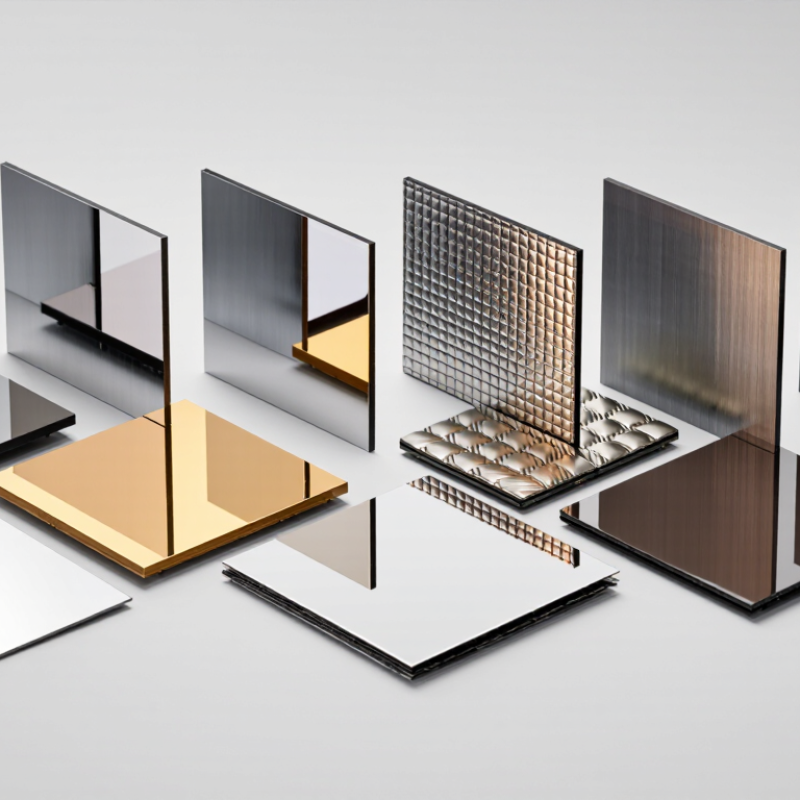
What Are the Top 10 Types of Mirrored Stainless Steel Sheets?
A mirrored stainless steel sheet is a flat metal product with a highly reflective surface. Its defining feature is the polish, not simply its bright appearance. Manufacturers progressively grind and polish the stainless surface until visible scratches and roughness are greatly reduced. The result can resemble glass, although it remains stronger and more resistant to heat. Surface quality depends on the stainless grade, polishing method, sheet thickness, and final inspection. Not every shiny sheet is a true mirror.
In practical inspections, view the sheet under angled light. A reliable mirror finish should reflect straight edges without noticeable waviness. Small distortions may appear on thin sheets, especially after cutting or bending. Fingerprints, polishing marks, and trapped dust can also change the visual effect. I have found that protective film helps during transport, but careless removal can leave adhesive residue. That detail is easy to underestimate. Reflectivity is important, yet corrosion resistance and fabrication performance still require equal attention. The best choice depends on the intended environment, cleaning routine, and installation method.
Tips: Check the surface from several angles before acceptance. Use a soft, clean cloth for handling. Avoid abrasive pads, which can create dull lines. Confirm the sheet’s grade, thickness, and finish standard with reliable inspection records. Even experienced buyers should compare a sample against the final delivery, because lighting can hide minor imperfections.
Comparison of common mirror-polished, decorative, coated, and patterned stainless steel sheet surfaces.
| No. | Type of Sheet | Primary Production Method | Typical Appearance | Common Stainless Grades | Reflective Performance | Typical Applications | Important Consideration |
|---|---|---|---|---|---|---|---|
| 1 | No. 8 Mirror Polished Sheet | Progressive mechanical polishing using fine abrasives, followed by buffing. | Bright, near-mirror surface | 304, 316, 316L | Very high reflection when the surface is clean and free from scratches. | Architectural panels, elevator interiors, columns, decorative wall cladding, food-service areas. | The No. 8 designation is commonly used for highly reflective polished stainless steel, but finish quality is not identical among all suppliers. |
| 2 | 8K Mirror Sheet | Fine polishing and buffing intended to create a smooth, glossy surface. | Glossy mirror appearance | 304 and 316L are common; other austenitic grades may also be used. | High reflection with a relatively uniform visual finish. | Interior decoration, furniture panels, display areas, signage, ceiling features. | “8K” is a commercial finish term and should be confirmed with a physical sample or agreed inspection standard. |
| 3 | Super Mirror Sheet | Additional fine abrasive polishing and careful buffing beyond a standard mirror finish. | Sharper, clearer reflection | 304, 316L, and other corrosion-resistant stainless grades. | Extremely high visual reflectivity and improved image clarity compared with ordinary polished finishes. | Premium architectural interiors, luxury fixtures, feature walls, decorative doors. | It requires careful handling because fingerprints, transport marks, and fine scratches are highly visible. |
| 4 | Bright-Annealed Mirror-Like Sheet | Cold rolling followed by annealing in a controlled atmosphere that limits oxidation. | Smooth, bright, reflective | 304, 316L, 321, and similar heat-resistant or corrosion-resistant grades. | Reflective, but usually less optically mirror-like than a fully buffed No. 8 or super mirror finish. | Appliances, tubing-related components, clean equipment, kitchen and interior applications. | Bright annealed is a smooth mill finish; it should not automatically be treated as an optical mirror finish. |
| 5 | Colored Mirror Sheet | Mirror polishing followed by a colored surface treatment, commonly vacuum-deposited PVD coating. | Colored metallic reflection | 304 is widely used; 316L may be selected for higher corrosion resistance. | Maintains a reflective base while adding colors such as gold, bronze, black, blue, or other decorative tones. | Feature walls, retail interiors, hospitality spaces, furniture, decorative doors and panels. | Color durability depends on coating quality, cleaning chemicals, abrasion, and the installation environment. |
| 6 | Etched Mirror Sheet | A mirror-polished surface is chemically or mechanically etched in selected areas to create a design. | Mirror and matte contrast | 304 and 316L are common choices. | Unetched areas remain highly reflective, while etched areas provide a satin or matte contrast. | Decorative partitions, elevator panels, wall features, doors, screens, and interior graphics. | Patterns should be specified clearly because etching depth, texture, and contrast can differ significantly. |
| 7 | Embossed Mirror Sheet | A reflective sheet is mechanically textured with a raised or recessed pattern. | Reflective patterned relief | 304 and 316L; grade selection depends on corrosion and forming requirements. | Reflection is broken into highlights and shadows by the three-dimensional pattern. | Interior wall panels, ceilings, decorative furniture, elevator features, and architectural accents. | Embossing changes the flatness and may affect cutting, forming, cleaning, and protective-film removal. |
| 8 | Vibration-Finish Mirror Sheet | Mirror polishing is combined with controlled multidirectional polishing marks. | Random decorative movement | 304 and 316L are frequently selected. | Reflective overall appearance with irregular visual marks that reduce the prominence of minor handling scratches. | Wall cladding, elevator interiors, columns, reception areas, and decorative panels. | The pattern is intentionally non-directional; matching separate sheets may require production from the same batch. |
| 9 | Antique Mirror Stainless Sheet | A polished or colored reflective surface is selectively distressed, textured, or treated to create an aged appearance. | Aged, mottled reflection | 304 and 316L are typical substrates. | Moderate to high decorative reflection, intentionally interrupted by cloudy, worn, or irregular areas. | Feature walls, hospitality interiors, restaurants, retail displays, furniture, and decorative screens. | The aged effect is decorative rather than a sign of corrosion; cleaning and maintenance instructions should be followed carefully. |
| 10 | Perforated Mirror Sheet | A mirror-polished sheet is punched or laser-perforated with a regular hole pattern. | Reflective surface with openings | 304 and 316L are common; thickness and hole geometry depend on structural needs. | Reflective between perforations, with transparency, ventilation, or visual screening provided by the openings. | Decorative screens, ceilings, façades, balustrade infill, equipment covers, and interior partitions. | Perforation reduces the continuous reflective area and may create sharp edges unless the sheet is properly deburred. |
Note: Mirror finish names are used differently across markets. For purchasing, specify the stainless steel grade, thickness, finish description, surface protection, allowable defects, dimensions, and an approved reference sample.
"*" indicates required fields