"*" indicates required fields
Choosing Airport Flood Lights in 2026 is no longer a simple wattage decision. Airport operators must balance visibility, glare control, energy use, weather resistance, and maintenance access. A bright fixture can still create dangerous reflections on wet aprons or cockpit windows.
Transportation-lighting researcher John D. Bullough offers a useful principle: “Visibility is the foundation of safe lighting.” That idea should guide every selection. The right fixture must illuminate aircraft stands, taxiway edges, service roads, and loading zones without disturbing pilots or nearby communities.
This guide examines LED output, beam distribution, color quality, surge protection, IP ratings, corrosion resistance, and smart-control compatibility. It also considers local climate conditions. Coastal airports may need stronger protection against salt air. Cold regions require reliable starting and stable performance below freezing.
Look beyond the product brochure. Ask for photometric data, test reports, warranty terms, and documented operating temperatures. Confirm whether the proposed beam pattern matches the apron layout. A narrow beam may leave dark areas between parked aircraft. A wide beam may waste light beyond the operational boundary.
No specification is perfect. Real sites contain dust, rain, shadows, aging cables, and unexpected maintenance vehicles. I would not choose Airport Flood Lights from lumen ratings alone. Field trials and nighttime inspections often reveal problems that drawings miss. The following sections provide a practical framework for making a safer, more durable, and more accountable choice in 2026.
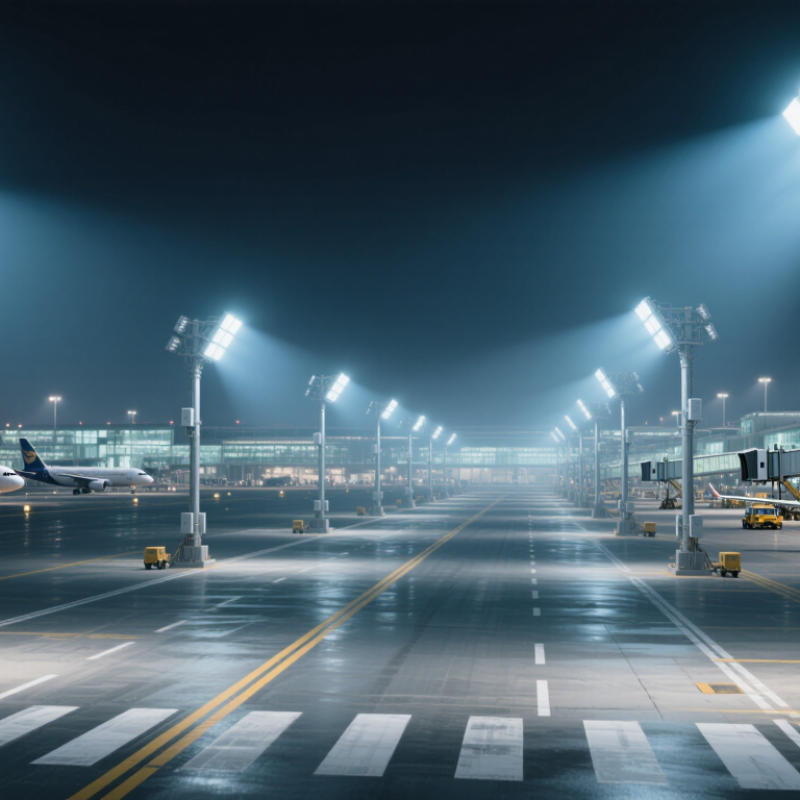
Airport apron lighting should begin with the task, not the fixture. Classify aircraft parking, marshalling, fueling, baggage handling, cargo movement, maintenance, and passenger access separately. Each task creates different visual demands. A marshaller needs clear hand signals. A mechanic needs stable light across small components. Drivers need fewer dark pockets near moving aircraft.
FAA AC 150/5340-30J should guide the design review. Check its applicable apron floodlighting provisions with current FAA project guidance and airport requirements. Evaluate illuminance, uniformity, glare control, mounting height, aiming angles, and interference with pilots or the control tower. Photometric calculations matter, but they are not enough. Walk the apron after dark. Wet pavement can create sharp reflections. A light that looks efficient on paper may still distract a pilot.
Use separate lighting zones for parking stands, service roads, and work areas. Add controllable levels for low-activity periods, while preserving safe visibility. Select durable housings, sealed optics, and accessible maintenance points. Emergency access also deserves attention. Do not hide it in the final review.
Experience shows that poor aiming causes many failures. Too much upward light wastes energy and creates glare. Excessive contrast can be tiring during long shifts. I would also question a design approved only in dry conditions. Test the installation at night, record measured values, and involve airport operations before acceptance. Human feedback can reveal problems that software misses.
Airport floodlight selection should begin with measured lighting targets, not fixture wattage. Use current IES airport lighting guidance alongside local aviation requirements. Define maintained illuminance for each zone, including aprons, service roads, hangars, and aircraft stands. A busy apron may need different lux levels from a quiet maintenance area. Do not use one target everywhere.
Uniformity matters as much as average lux. Set a minimum-to-average or minimum-to-maximum ratio for each working surface. Then test the design on a detailed grid. Include aircraft shadows, pavement reflectance, pole spacing, and changing maintenance conditions.
Initial readings can look excellent. They may decline after dirt, aging, and lumen depreciation. Apply a realistic maintenance factor.
Glare requires deliberate control. Review high-angle intensity toward pilots, ground crews, control rooms, and nearby roads. Choose optics that place light on the pavement, not into cockpit windows. Shielding, aiming limits, and carefully selected mounting heights can reduce visual discomfort. Check spill light beyond the airport boundary.
Flicker, harsh contrast, and poor color rendering also deserve attention during night trials. A photometric report is useful, but it is not the whole answer. On-site observation can expose problems that software misses. One weakness remains common: designers sometimes optimize lux while accepting uncomfortable glare. That trade-off deserves another review.
How to Choose Airport Flood Lights in 2026?
Airport flood lights should be compared by delivered lumens, not LED chip claims. The U.S. Department of Energy’s solid-state lighting reports place modern outdoor LED performance broadly near 100–150 lm/W, depending on optics, temperature, and driver losses. Ask suppliers for complete-luminaire efficacy, tested at operating temperature. A 150 lm/W datasheet may become 125 lm/W after housing, lens, and control losses.
CRI affects runway signs, service vehicles, paint markings, and maintenance decisions. For most apron and terminal areas, CRI 70 is a practical baseline; CRI 80 can improve color recognition where inspections occur. CCT between 4000K and 5000K often provides crisp visibility without the harsh blue appearance of very cool light. The Illuminating Engineering Society recommends evaluating glare, uniformity, and adaptation alongside basic photometric output. More lumens alone can create unsafe contrast.
Check L70 evidence carefully. LM-80 measures LED lumen maintenance, while TM-21 projects long-term performance; neither test guarantees identical field conditions. A 100,000-hour L70 claim deserves operating-temperature data, not only laboratory optimism. DOE reliability research has repeatedly identified heat as a major factor in LED lifetime. In my field evaluations, poor aiming and dirty optics often undermine excellent specifications. I would also question whether a higher CRI justifies lower efficacy in every zone; sometimes it does, sometimes it does not. Test one installed bay at night.
| Application Profile | Recommended LED Efficacy | Typical CRI | Recommended CCT | Target L70 Lifetime | Typical Mounting Area | Optical and Control Priorities | Selection Rationale |
|---|---|---|---|---|---|---|---|
| Apron and Aircraft Stand Flood Light | 120–150 lm/W | CRI ≥ 70 CRI ≥ 80 where color recognition is important | 4000–5000 K | ≥ 100,000 hours | High masts, typically 20–40 m | Asymmetric optics, low glare, precise spill-light control, dimming and remote monitoring | High efficacy reduces energy use during long operating hours, while controlled optics help limit glare for pilots, ground crews, and nearby roads. |
| Aircraft Maintenance and Hangar Perimeter | 110–140 lm/W | CRI ≥ 80 | 4000–5000 K | ≥ 100,000 hours | Building façades, poles, and service yards | Wide distribution, uniform illumination, adjustable brackets, occupancy or scheduling controls | CRI 80 or higher improves recognition of aircraft finishes, equipment, warning markings, and maintenance details. |
| Taxiway Service and Operations Area | 100–135 lm/W | CRI ≥ 70 | 4000 K | ≥ 80,000 hours | Low and medium-height poles beside service routes | Shielded optics, uniformity, narrow or medium beam options, photocell and central control compatibility | A balanced specification provides efficient visibility for service vehicles while reducing unnecessary light trespass toward aircraft movement areas. |
| Runway and Airfield Maintenance Compound | 120–145 lm/W | CRI ≥ 70 | 4000–5000 K | ≥ 100,000 hours | Equipment yards, workshops, and maintenance access roads | Robust housing, impact resistance, surge protection, broad uniform distribution | High efficacy and long L70 reduce relamping frequency in areas where access equipment and nighttime work can be disruptive. |
| Terminal Roadway and Curbside Area | 110–140 lm/W | CRI ≥ 80 | 3000–4000 K | ≥ 100,000 hours | Roadside poles, canopies, and drop-off zones | Low-glare optics, good facial and signage visibility, adaptive dimming, warm-to-neutral CCT | CRI 80 and a 3000–4000 K range can support comfortable passenger areas while maintaining clear visibility and traffic safety. |
| Perimeter Security and Cargo Yard | 100–130 lm/W | CRI ≥ 70 CRI ≥ 80 for video monitoring | 4000–5000 K | ≥ 100,000 hours | Perimeter poles, gates, and logistics yards | Uniform vertical illumination, camera-compatible flicker performance, motion sensors, full cutoff where required | Uniformity and vertical illumination can be more important than maximum lumen output for security observation and CCTV performance. |
| Coastal or De-Icing Exposure Area | 100–135 lm/W | CRI ≥ 70 | 4000 K | ≥ 80,000 hours | Exposed apron edges and winter-service zones | IP66 or higher, corrosion-resistant finish, suitable impact rating, pressure-equalization membrane, surge protection | Environmental protection and thermal management should be prioritized because salt, moisture, chemicals, vibration, and temperature changes can shorten service life. |
Technical note: Efficacy values are luminaire-level target ranges rather than LED-chip-only ratings. L70 indicates the estimated operating time until light output reaches 70% of its initial value under stated thermal, electrical, and maintenance conditions. Final selection should be confirmed through a site-specific photometric study, glare assessment, environmental review, and applicable aviation regulations.
For airport flood lights, begin with the enclosure rating, not the lamp output. IEC 60529 defines IP protection against dust and water. IP66 means dust-tight protection and resistance to powerful water jets. IP67 adds temporary immersion protection, usually up to one metre. However, IP67 does not automatically guarantee strong water-jet resistance. Specify both ratings when cleaning methods and flooding risks demand them. This detail is often overlooked.
Impact protection needs separate evidence. IEC 62262 defines IK ratings, while IK08 withstands a 5-joule impact. For exposed apron poles, service roads, and maintenance areas, IK08 may be a sensible minimum. IK09 or IK10 could provide greater resilience where equipment faces tools, debris, or accidental contact. Ask for test reports matching the complete housing, lens, and mounting assembly. Test evidence matters.
Wind loads require another calculation. IEC 60529 and IEC 62262 do not establish pole wind resistance. Use the project’s structural code, local wind map, mounting height, projected area, and gust speed. A large floodlight can behave like a sail. Specify the fixture’s allowable wind load, fixing method, vibration limits, and corrosion protection. I have seen projects focus heavily on IP ratings while underchecking brackets. That is an imperfect approach. Recheck drainage, cable glands, thermal performance, and maintenance access before approval.
Airport flood lights must prove more than brightness. Start with application data, including mounting height, beam angle, glare limits, and required uniformity. A 50,000-hour L70 rating means light output may remain at 70 percent after that period. It is not a guarantee of failure-free operation. Ask for test conditions, temperature assumptions, and the exact LED driver used. Small differences matter.
Validate electromagnetic compatibility before installation. Request EMC test reports for the complete fixture, not only the LED module. Poorly controlled emissions can affect radios, navigation support equipment, or nearby communication systems. Confirm immunity performance as well. Controls should support dimming, scheduling, fault alerts, and manual override. They must also recover safely after power interruptions. Compatibility with existing airport systems deserves a live test. Documents alone can miss practical problems.
Tips: Compare total cost, not the purchase price. Include energy use, control hardware, installation lifts, cleaning, inspections, spare drivers, and future replacement labor. Check whether the 50,000-hour claim changes under heat, dust, or frequent dimming. Ask for photometric files and a sample installation area. Watch for glare on wet pavement. I have seen inexpensive fixtures become costly after repeated access work. That lesson is easy to overlook. A careful trial may delay procurement, but it can expose weak controls, radio interference, or uneven lighting before the runway environment depends on them.
"*" indicates required fields