China Best ODM O Rubber Ring Manufacturer for Global Buyers
Choosing the China Best ODM O Rubber Ring Manufacturer requires more than comparing prices or reviewing polished factory photos. Global buyers need evidence, technical communication, and repeatable production. An experienced ODM O Rubber Ring Manufacturer should understand compound selection, mold design, dimensional control, and application risks. The ring may look simple. Its failure may not be.
Philip Crosby, a respected manufacturing quality expert, said, “You cannot inspect quality into a product; you must build quality into it.” This principle matters when developing custom O-rings for pumps, valves, hydraulic systems, medical equipment, or industrial machinery. A dependable supplier should discuss NBR, EPDM, FKM, silicone, hardness, temperature limits, chemical exposure, compression set, and sealing pressure. It should also explain why one material fits a drawing, while another only appears cheaper.
Real evaluation happens through details. Ask for material certificates, sample measurements, tooling information, inspection records, and batch traceability. Check whether the supplier confirms tolerances before cutting steel. Review how prototypes are tested at actual temperatures and pressures. Small gaps often become expensive delays.
No manufacturer is perfect. Even a strong partner may need clearer drawings, better feedback, or another trial mold. That is worth admitting. Honest limitations are more useful than impressive promises. This guide examines how global buyers can assess a China-based ODM O Rubber Ring Manufacturer through engineering capability, communication, quality systems, production experience, and dependable delivery. The goal is not merely to find a factory, but to build a sealing solution that performs consistently in the field.
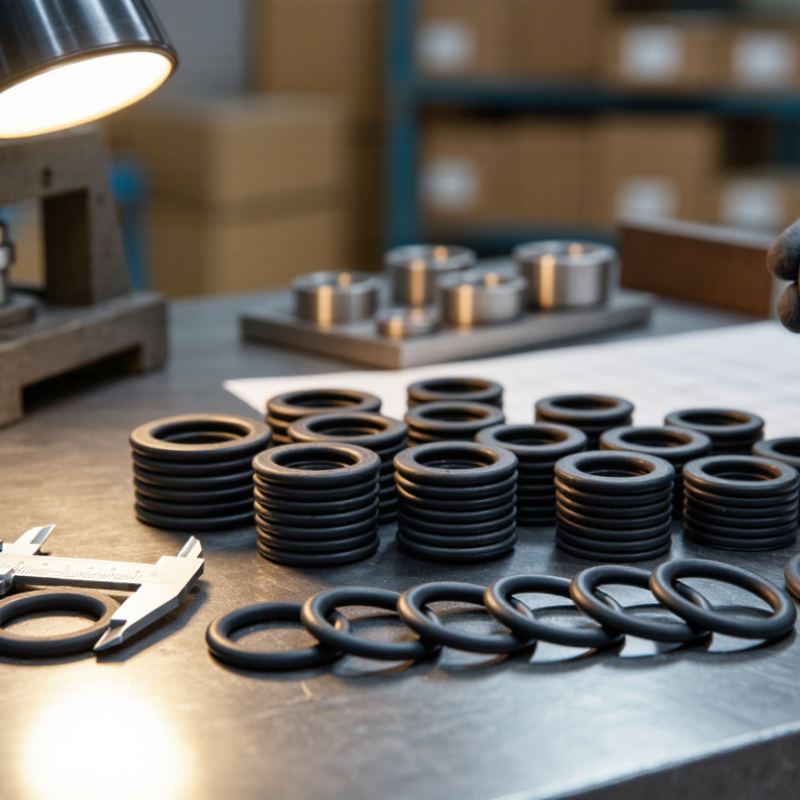
ODM O-Ring Manufacturing in China: ISO 3601 Sizes and Tolerances
China Best ODM O Rubber Ring Manufacturer for Global Buyers
ODM O-ring manufacturing in China works best when ISO 3601 controls the conversation. The standard defines O-ring dimensions, designation methods, and dimensional tolerances for reliable interchangeability. For example, an engineer can specify a 25 mm inside diameter and select the correct cross-section from an ISO 3601 size series. The factory should then verify inside diameter, cross-section, flash, and surface defects.
Inspection must go beyond a supplier’s certificate. In practical production, calibrated vision systems measure each batch, while sampling checks hardness and compression set. ISO 3601 tolerances are not optional suggestions. They affect sealing pressure, groove fill, and leakage risk. Grand View Research reported that the global industrial seals market reached about USD 12.39 billion in 2023, with continued growth expected through 2030. This wider market data shows why consistent sealing components matter across machinery, fluid systems, and industrial equipment.
Tips: Send a complete drawing, medium, temperature range, pressure, and groove details. Ask for first-article inspection records and lot traceability. Confirm whether measurements follow ISO 3601 methods. Small omissions create expensive revisions. A perfect drawing still cannot replace material validation. Shore hardness may match, yet swelling performance can differ. That is an uncomfortable detail, but it deserves review before mass production.
Material Selection: NBR, FKM, EPDM, and Silicone Temperature Ranges
For global buyers, selecting the correct O-rubber ring material starts with temperature, not price. An experienced ODM manufacturer should review the real operating environment, including heat cycles, pressure, fluids, and installation conditions.
NBR usually performs from about -40°C to 120°C. It suits mineral oils, hydraulic fluids, and general mechanical sealing.
FKM commonly handles around -20°C to 200°C, with better resistance to fuels, oils, and aggressive chemicals. However, low-temperature flexibility may become limited.
EPDM often works from -50°C to 150°C and performs well with hot water, steam, and weather exposure. It should not be selected for petroleum-based oils without careful validation.
Silicone can operate from approximately -60°C to 200°C. It remains flexible in cold environments, but its tear strength and abrasion resistance need attention.
These ranges are practical references, not universal guarantees. Compound formulation, hardness, compression, pressure, and contact media can change performance significantly.
A reliable ODM process should include material certificates, dimensional inspection, compression testing, and batch traceability. Sample testing under actual conditions is still necessary. We have seen seals pass basic temperature tests yet fail after repeated pressure cycling. That detail is easy to overlook. Clear drawings, tolerance requirements, and service-life expectations help engineers recommend a more dependable material and tooling design.
Engineering Control: 70 Shore A Hardness and ≤25% Compression Set
An ODM O-ring is judged by performance, not diameter alone. At 70 Shore A, the rubber balances flexibility, sealing contact, and resistance to extrusion. That balance matters.
Hardness alone can mislead. ISO 48-4 and ASTM D2240 provide recognized methods for measuring rubber hardness. A compression set of no more than 25% should also be verified under controlled conditions. ASTM D395 Method B and ISO 815-1 evaluate permanent deformation after compression, temperature exposure, and recovery time. Test temperature matters.
The International Rubber Study Group’s 2024 outlook places global rubber demand at approximately 31 million tonnes annually. This scale increases pressure for repeatable compound control and traceable inspection. In production, each lot should record hardness, tensile strength, elongation, dimensions, curing conditions, and compression-set results. Samples should represent the actual molding batch, not only laboratory plaques.
A polished certificate is not enough. One compression-set result cannot predict every field condition, especially with heat, pressure, lubricant contact, or uneven grooves. We still find dimensional variation after curing. That weakness deserves attention. Buyers should request test temperatures, dwell times, sampling plans, and raw data before approval. Practical verification at the intended operating temperature remains essential.
Quality Testing: ASTM D2000, Leakage Tests, and Batch Traceability
China Best ODM O Rubber Ring Manufacturer for Global Buyers
For an ODM O rubber ring manufacturer, quality starts before molding. ASTM D2000 helps classify rubber compounds by hardness, tensile strength, elongation, and heat resistance. It is a useful framework, not a shortcut. Our engineers compare drawings, operating temperatures, pressure ranges, and chemical exposure before selecting materials. Each production lot receives dimensional checks, hardness readings, and visual inspections. Small surface marks can become serious leakage paths.
Tips: Request sample test reports, lot numbers, and clear acceptance limits. Ask how failed samples are isolated. A report without traceability is weak evidence.
Leakage testing should reflect real service conditions. Depending on the application, we use pressure decay, vacuum, or liquid immersion methods. Test fixtures must control pressure, temperature, and holding time. Results should record the measured loss, test medium, and equipment status. Batch traceability connects each ring to its compound record, mold, curing data, inspection results, and shipment carton. This supports faster investigation when performance changes. Still, no test plan is perfect. A ring may pass a short laboratory test yet fail after long compression. That risk deserves review. Experienced buyers should also examine storage conditions, compression set data, and retest procedures. Clear records build trust across international supply chains, even when an unexpected result requires honest correction.
Global Buyer Guide: MOQ, PPAP Documents, and ISO 9001 Supplier Audits
China Best ODM O-Ring Manufacturer for Global Buyers
For global buyers, MOQ is more than a purchasing number. It reflects tooling, rubber compound, color, packaging, and production stability. Ask how the MOQ changes with standard and custom sizes. A lower MOQ may increase unit cost or cause unused material. Request a written quotation with tooling fees, sample charges, lead times, and replacement terms. One practical lesson is simple: cheap samples do not prove reliable mass production.
Tips: Share your drawings, application temperature, pressure range, and required hardness early. Ask for traceable material certificates. Keep approved samples and inspection records together. This prevents confusion when several sizes look almost identical.
PPAP readiness should be checked before the purchase order. A capable ODM supplier should explain its process flow, PFMEA, control plan, dimensional results, material data, MSA records, capability studies, and PSW. The exact package may depend on your industry and risk level. Do not accept a document folder without evidence. Compare the PPAP measurements with your drawing tolerances. Small gaps matter. A missing revision date can create serious problems later.
An ISO 9001 certificate supports confidence, but it is not a substitute for an audit. Review incoming rubber inspection, mold maintenance, batch identification, nonconformance handling, and corrective actions. Walk through production if possible. Check whether operators follow the posted procedures. Audits are imperfect. A clean meeting room proves little. Ask for recent records, including a rejected batch and its final disposition. That uncomfortable detail often reveals the supplier’s real quality discipline.
