What Is the Best China Extruded Heat Sink Supplier?
Choosing the best China Extruded Heat Sink supplier requires more than comparing catalog prices. A reliable supplier must connect aluminum quality, extrusion control, machining accuracy, and thermal performance. The right partner should provide clear alloy information, engineering drawings, inspection records, and consistent production evidence.
Dr. Satish Kandlikar, a respected thermal-management researcher, has stated, “Thermal performance depends on the complete system, not one component alone.” This principle matters when evaluating an Extruded Heat Sink. Fin spacing, base thickness, airflow, mounting pressure, and interface material all influence actual cooling results. A supplier may advertise excellent conductivity, yet poor flatness can increase contact resistance. Small details matter.
Look closely.
Experienced buyers should request samples before approving mass production. Examine the extrusion surface for tearing, uneven fins, and visible die marks. Ask how the factory controls aluminum alloy composition and dimensional tolerances. Independent testing can verify thermal resistance under realistic airflow conditions. Photographs are useful, but test data is stronger.
The best China Extruded Heat Sink supplier is not automatically the cheapest option. It should demonstrate stable tooling, responsive engineering support, dependable packaging, and traceable quality control. Certifications can support credibility, but they do not replace practical verification. I would also question suppliers promising unusually short lead times without explaining capacity. That promise may be attractive, but it deserves scrutiny.
A careful decision compares cooling performance, production consistency, communication, and long-term risk. No supplier is perfect. The strongest choice is usually the one that openly discusses limitations and improves them with measurable actions.
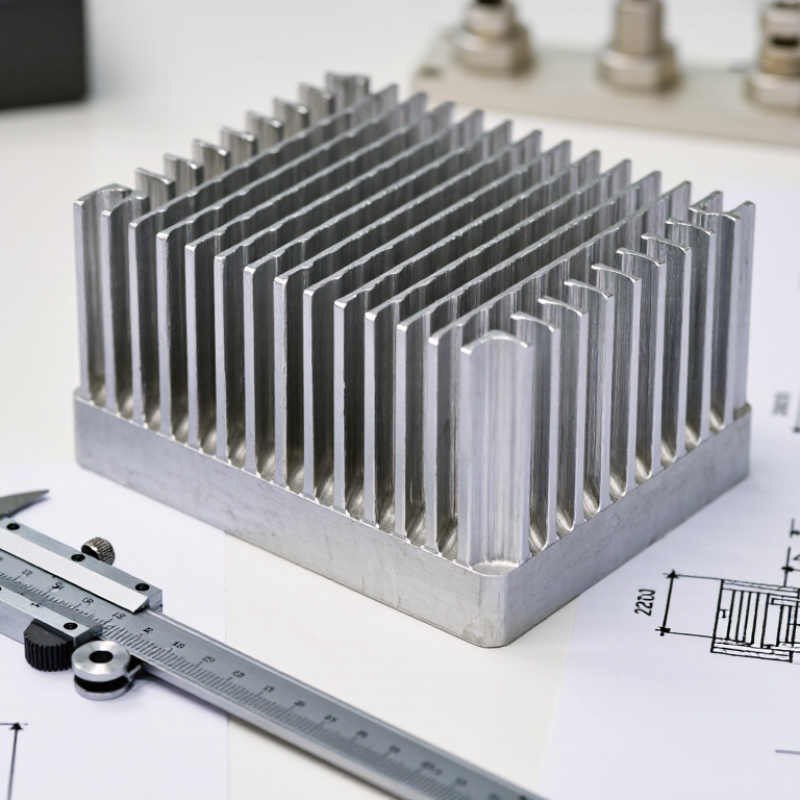
Aluminum 6063-T5: Why ~201 W/m·K Thermal Conductivity Matters
What Is the Best China Extruded Heat Sink Supplier?
Aluminum 6063-T5 is widely used for extruded heat sinks because it balances conductivity, strength, and extrusion quality. ASM Handbook, Volume 2, reports thermal conductivity near 201 W/m·K for 6063 aluminum at room temperature. This value supports fast heat spreading from LEDs, power modules, and compact control systems. It is not a guarantee.
The real result depends on fin geometry, surface contact, airflow, and operating temperature. A 201 W/m·K material can still perform poorly with thin mounting plates or uneven machining. Thermal resistance matters more than conductivity alone. For example, a dusty fin channel can quietly reduce cooling efficiency.
The Aluminum Association’s Aluminum Standards and Data identifies 6063-T5 as an extrudable architectural alloy with useful temper control. A reliable supplier should provide heat-lot traceability, chemical composition, temper records, and dimensional inspection. ASTM E1461 testing can verify thermal diffusivity before calculating conductivity. This is a practical checkpoint, not marketing language.
Supplier evaluation should include fin straightness, burr control, flatness, and anodizing thickness. Ask for sample profiles before approving production. One overlooked detail remains contact pressure. Too much pressure may deform the base; too little leaves microscopic air gaps. The best supplier is therefore not simply the one quoting 201 W/m·K, but the one proving consistent performance across real production batches.
Extrusion Capability: Profiles, ±0.1 mm Tolerance, and Fin Ratios
The best China extruded heat sink supplier should prove its extrusion capability with measured profiles, not attractive drawings. The Aluminum Association’s 2024 Aluminum Standards and Data emphasizes that extrusion tolerances depend on section size, alloy, and wall geometry. Therefore, a claimed ±0.1 mm tolerance needs context. Ask for inspection records from a coordinate measuring machine, temperature-controlled gauges, and a defined measurement datum. For a 6063-T5 heat sink, the supplier should report results across fin roots, mounting faces, and overall width. One sample is not enough.
Fin ratios reveal practical engineering skill. A fin ratio usually compares fin height with fin thickness. For example, a 12 mm fin with a 1 mm thickness gives a 12:1 ratio. Higher ratios improve surface area, but they also increase bending, die wear, and air-flow resistance. The U.S. Department of Energy’s 2023 Solid-State Lighting R&D Opportunities report identifies thermal control as a continuing design requirement for LED systems. That supports careful fin spacing, not simply taller fins. Many extrusion designs use 8:1 to 15:1 ratios, depending on alloy, die design, and cooling method. The number alone proves little.
Request a die-flow simulation, trial samples, and a batch capability study. Look for Cpk data, not vague “precision” claims. A Cpk above 1.33 is commonly used for stable production, although project requirements vary. In practice, ±0.1 mm may be achievable on selected features, but not every complex fin. I would challenge any supplier promising it everywhere. That sounds convenient, yet technically weak.
Thermal Validation: Comparing Rθ Values Below 0.5°C/W
What Is the Best China Extruded Heat Sink Supplier?
Thermal Validation: Comparing Rθ Values Below 0.5°C/W
When comparing extruded heat sink suppliers, an Rθ value below 0.5°C/W looks impressive. However, the number means little without test conditions. A reliable supplier should state the measured heat load, airflow speed, ambient temperature, mounting method, and orientation. In practical testing, a 100-watt load with 1 m/s airflow can produce very different results from natural convection. Ask for the complete test setup.
Small details matter. A 300-millimeter aluminum extrusion may reach 0.42°C/W with forced airflow, but exceed 0.7°C/W without it. Check the interface material, too. A thin thermal pad can add noticeable resistance between the device and base. Flatness also affects contact quality. We have seen two identical profiles perform differently because one base had uneven machining. That result was easy to overlook.
Test evidence builds trust. Request thermal curves, sample dimensions, alloy information, and repeatability data from multiple units. Three samples are better than one. Five are more convincing. Infrared images can help locate hot spots, but thermocouples and calibrated sensors provide stronger verification. Our own early comparisons relied too heavily on catalog values. That was a mistake. A capable supplier should welcome independent testing and explain deviations clearly. Rθ is not a fixed promise; it is a measured result under defined conditions.
Supplier Selection: MOQ, Lead Time, Surface Finish, and Total Cost per Unit
What Is the Best China Extruded Heat Sink Supplier?
Supplier selection should begin with MOQ, not attractive catalog photos. A low MOQ helps validate thermal performance before a large commitment. For a custom profile, ask whether tooling charges are separate from the unit price. Confirm aluminum alloy, profile tolerance, cutting accuracy, and packaging details in writing. These details affect assembly time and heat transfer.
Lead time needs practical testing. Request separate dates for tooling, first samples, mass production, and inspection. A supplier promising seven days may exclude extrusion die preparation. That estimate can be too optimistic. In my experience, a written production schedule is more useful than a fast verbal promise. Keep several spare days for dimensional corrections. Small delays become expensive when electronics are waiting.
Surface finish also changes the real cost. Anodizing can improve corrosion resistance and appearance, but color matching may require additional samples. Ask for finish thickness, visual standards, and acceptable marks. Calculate total cost per unit, including tooling, machining, anodizing, inspection, packaging, freight, and rejected parts. A cheaper profile may need extra deburring or manual fitting. Check the math carefully. I once focused too heavily on the quoted extrusion price and underestimated packaging damage. A reliable supplier should provide samples, inspection records, clear payment terms, and traceable production communication.
